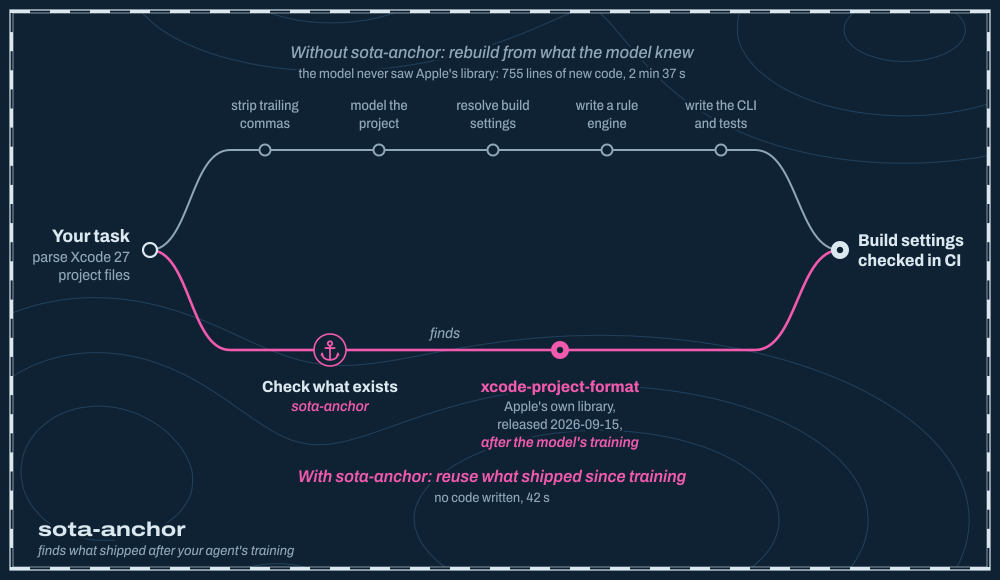
The problem: plans built on a knowledge cutoff
A coding agent plans from what it learned in training. When a task needs something it hasn’t heard of, it assumes that thing doesn’t exist, and does one of two expensive things: builds it from scratch, or tells you it can’t be done. Often the library, file reader or model that makes the job easy was published after its training ended.
In the session above, the agent was asked for a parser for Xcode 27’s new project format. Without sota-anchor it wrote eight files and 755 lines from scratch. With sota-anchor it found xcode-project-format, Apple’s own library for the format, released on 2026-09-15, and asked what the CI check should enforce instead.
How it works
- Invert. The agent names what its plan assumes doesn’t exist, such as “no library reads this format yet”, and writes two search queries.
- Search. sota-anchor searches the last 12 months of arXiv, Hugging Face, GitHub, npm and crates.io (plus the web with an optional Brave key), all inside one 60-second budget.
- Judge. The agent weighs only what came back, with dates. It reuses what exists, builds knowing nothing better does, or says plainly that nothing was found. Silence is never treated as a verdict.
Nothing in the code knows about any one domain, so the same check works for a CAD file format, a genomics pipeline or a compiler pass. Your agent does the reasoning and sota-anchor does the retrieval, so there’s no extra API key.
Current model IDs, every session
In Claude Code, each session also starts with a short, dated list of the model API IDs that OpenRouter’s public registry serves today, so a new config names a model that actually exists instead of one remembered from training. Other agents get the same list through sota-anchor sync.
Install
In Claude Code (needs Python 3.11+ and uv, no API key):
For Cursor, VS Code with GitHub Copilot, OpenAI Codex CLI, Gemini CLI, OpenCode or any other MCP client, install the CLI and register the check_what_exists MCP tool:
sota-anchor is published on PyPI and the MCP registry. The test suite runs fully offline, CI covers Ubuntu and Windows on Python 3.11 to 3.14, and releases ship through PyPI trusted publishing.